
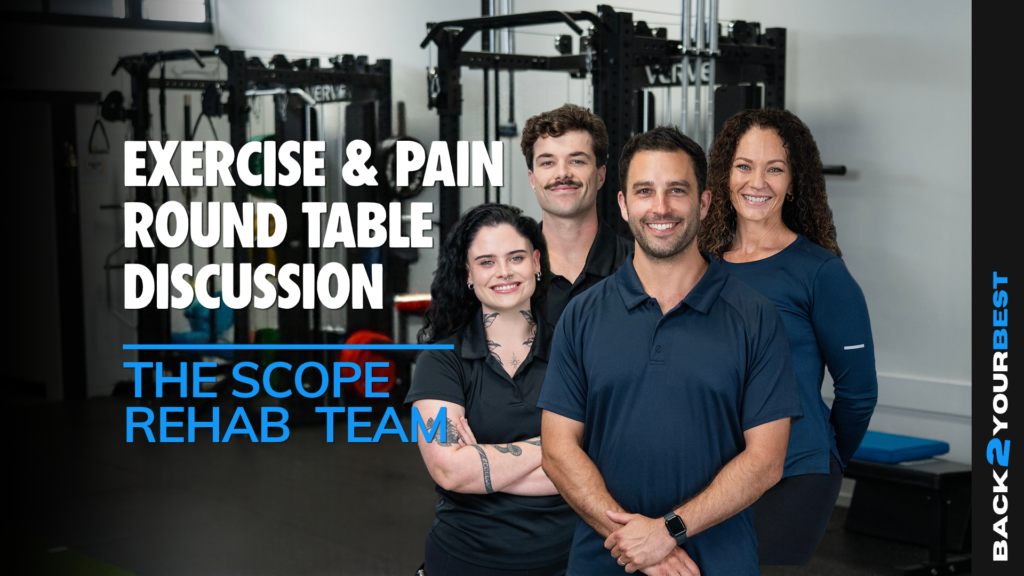


By Daniel Rothenberg, Sports Chiropractor and Strength & Conditioning Coach, Scope Sports Injury & Exercise Clinic
You arrive at the gym ready to train, but your knee feels uncomfortable during a squat. Do you stop the session, push through or try something different?
It is a question we regularly discuss at our East Ipswich clinic. The answer depends on what is causing the symptoms, how the body part is functioning and what happens when the exercise is adjusted.
In our latest Back 2 Your Best Rehab Podcast episode, Luke, Amelia, Ange and I explored the decisions behind exercising with pain. A useful starting point is to understand the symptom, identify anything that needs assessment and look for appropriate ways to keep working towards your goals.
Pain deserves attention—and context
Pain is a real experience. It is influenced by physical, psychological and social factors, and its intensity is not a direct measurement of tissue damage. [1]
That helps explain why a familiar movement can feel different on different days. It does not establish that every painful movement is harmless or that pain can be dismissed.
Someone with a known persistent condition and an agreed exercise plan is in a different situation from someone with a new injury, an undiagnosed swollen joint or a recent operation. Understanding that context comes before deciding how much to do.
For chronic primary pain specifically, NICE recommends appropriately tailored supervised exercise and encourages physical activity for longer-term health. This recommendation does not override restrictions for acute injuries, fractures or healing surgical repairs. [2]
Start with a check-in before the workout
Ask yourself what has changed since your last session:
- Is this familiar discomfort, or a new symptom?
- Is there swelling, weakness, tingling or a change in walking?
- Has the area recovered from the previous session?
- Are you following any surgical or injury-specific restrictions?
In the podcast, we discussed how a person can be so committed to their program that they complete a planned run despite a sore, swollen knee. Commitment is valuable, but a program needs to respond to changes in symptoms.
A planned session is a proposal based on your expected capacity. A meaningful change is a reason to check in with the clinician or coach who wrote it.
A practical framework for deciding what to do
The team discussed a traffic-light approach. It is a communication tool, not a diagnosis or a universal pain-scoring rule.
| Response | What it might look like | Useful next step |
|---|---|---|
| Continue within your agreed plan | Familiar, manageable symptoms with steady movement and an acceptable recovery pattern for your condition. | Maintain the current dose and monitor. Avoid making several increases simply because one set felt comfortable. |
| Modify and review | Symptoms building across sets, a new limp, worse next-day function or swelling. | Reduce or stop the provoking task and seek advice about the next session, particularly for new or unexplained changes. |
| Stop and obtain assessment | A significant new injury, inability to bear weight, marked swelling, new neurological symptoms or severe escalating pain. | Pause the affected activity and obtain appropriate clinical assessment. Some symptoms need urgent care. |
There is no pain number that is automatically safe for everyone. Mild pain can matter in some injuries, while some persistent conditions can be managed with agreed levels of discomfort.
Five ways to modify exercise
1. Change the range of motion
A squat to a higher box may be more manageable than a deep squat. An elevated deadlift may be better tolerated than lifting from the floor.
The aim is to find a useful range now and review whether it can be expanded later. An easier version does not rule out a structural problem; it simply gives information about current tolerance.
2. Adjust the weight or how it is held
Reducing resistance can make a movement more manageable. Sometimes changing the exercise variation or position of the load also helps.
A front squat and a back squat distribute demands differently, so one may suit someone better. Neither is a universal solution for a painful knee or back.
3. Reduce sets or repetitions
A movement may feel fine at the start and become uncomfortable after repeated sets. In that situation, total work may need adjusting.
For example, a clinician might trial fewer sets and review the response before adding volume again. The right dose depends on the person; high-repetition exercises are not automatically gentler.
4. Leave more effort in reserve
Training close to the point where another repetition would be impossible can be demanding. Stopping earlier may be appropriate during a sensitive period.
“Repetitions in reserve” describes how many more good repetitions you estimate you could perform. It is an effort guide, not a pain limit or an exact percentage of maximum strength.
5. Adjust frequency or choose another task
Adding a recovery day may help when the same area is repeatedly loaded. If a suitable variation remains uncomfortable, choose an alternative with your coach rather than repeatedly provoking symptoms.
There is no compulsory order for these changes. Range, resistance and exercise choice should be selected according to the problem, rather than always keeping the same weight at a shorter range.
Check the response afterwards
One of the clearest messages from the team was to look beyond the session itself.
Record how the area feels later that day and over the next 24–48 hours. Note walking, stairs, sleep and other relevant tasks, as well as pain.
| What to record | Example |
|---|---|
| Exercise and dose | Box squat, chosen box height, weight, sets and repetitions. |
| Response during training | Comfortable initially; symptoms increased in the final set. |
| Later response | Mild stiffness that evening. |
| Next-day function | Stairs and walking unchanged, or clearly harder. |
| Decision | Maintain, adjust or request review according to the agreed plan. |
A delayed flare does not automatically mean a new injury. It does indicate that the plan needs interpretation. The 24–48-hour check is a useful review window, not a universal deadline by which every condition must return to baseline.
When to get urgent help
Back pain accompanied by new bladder or bowel changes or numbness around the genitals or saddle area requires urgent emergency assessment. New or progressive weakness also needs prompt medical attention. [3]
Other unexplained changes, including persistent swelling, worsening symptoms or repeated loss of function, deserve clinical review rather than repeated attempts to train through them.
Your practical takeaway
Before the next session, identify your current symptoms and restrictions. Choose a manageable version of the activity, agree what response is acceptable and review how you recover. Progress only when the overall pattern supports it.
If you are looking for an Ipswich chiropractor who can assess your symptoms and connect that assessment with exercise planning, ask how the clinician will review your actual training, explain modifications and coordinate follow-up.
References
- International Association for the Study of Pain. Terminology and definition of pain. https://www.iasp-pain.org/resources/terminology/
- NICE. Chronic pain: assessment and management, NG193. https://www.nice.org.uk/guidance/ng193/chapter/recommendations
- NICE. Suspected neurological conditions: recognition and referral, NG127. https://www.nice.org.uk/guidance/ng127/chapter/Recommendations-for-adults-aged-over-16
For support applying these principles, our Back 2 Your Best Rehab Program at Scope Sports Injury & Exercise Clinic, 5 Jacaranda Street, East Ipswich, combines individualised whole-body programming, expert rehab coaching, clinical appointments, progress testing and rehab gym access under one membership. We build a plan around your condition, current capacity and goals, and adjust it as you progress. Explore the program at www.back2yourbestrehab.com.au.